After a year and a half of semi-regularly updating The Bard of Boston website, I've decided to leave it behind and move on to a new online endeavor; one that better reflects what I've been up to during the past few months. So, to celebrate the end of an era, I leave you with "The Parting Glass," a song that date backs to at least the 17th century (probably earlier). Below you can find the lyrics as well as a performance of the song by Irish singer/songwriter Glen Hansard.
Of all the money that ere I had, I spent it in good company. And of all the harm that ere I've done, alas was done to none but me. And all I've done for want of wit, to memory now I cannot recall. So fill me to the parting glass. Goodnight and joy be with you all.
Of all the comrades that ere I had, they're sorry for my going away, And of all the sweethearts that ere I had , they wish me one more day to stay, But since it falls unto my lot that I should rise while you should not, I will gently rise and I'll softly call, "Goodnight and joy be with you all!"
Oh, if I had money enough to spend and leisure time to sit awhile There is a fair maid in this town that sorely has my heart beguiled Her rosey cheeks and ruby lips, she alone has my heart in thrall. So fill me to the parting glass. Goodnight and joy be with you all.
Ah, yes. The Fourth of July: that magical day when you can prove you're a true American patriot by stuffing your face with hamburgers and hotdogs, downing no less than 50 Budweisers (in honor of the 50 states, duh!), and drunkenly stumbling through the words of the "The Star-Spangled Banner" at a local fireworks display.
It's dawned on me that while we're busy lighting off firecrackers, shooting at squirrels in the backyard with our cousins' pellet guns, and crushing empty beer cans on our foreheads, we can sometimes forget why the hell we're even celebrating. There are some solid centuries of history behind the Fourth of July, and being better in touch with that history can not only help us justify our celebratory improprieties, but it can also help us shed the awful title of "ignorant Americans."
So, if a tourist comes up to you this Fourth of July, asking why you're partying so damn hard, have these following facts on hand.
The no-brainer: The Fourth of July (aka Independence Day) commemorates July 4th, 1776, which was when the Continental Congress approved the Declaration of Independence. Translation: it's our country's birthday.
However, Congress had already formally declared independence two days earlier on July 2nd, 1776. Declaration-signer and future-president John
Adams believed that the Second of July would be “the most memorable epocha in the history of
America.”
The common misconception: The engrossed (aka officially inscribed, aka legit) copy of the Declaration wasn't signed until August 2nd, 1776. And several delegates, specifically Elbridge Gerry,
Oliver Wolcott, Lewis Morris, Thomas McKean, and Matthew
Thornton, didn't sign until an even later date.
Just to be clear: The approval of the Declaration of Independence on July 4th, 1776 didn't mark the end of the Revolutionary War, nor did the signing of it on August 2nd, 1776. The American Revolution didn't end until September 3rd, 1783 (with the signing of the Treaty of Paris). This means we declared ourselves a free country well before we were 100% sure that we'd actually get to keep our freedom. (Good thing we won!)
Why do we celebrate the Fourth of July and not the Second of July or the Third of September or some other date? Bottom line: we had to pick a date to celebrate. But the approval of the Declaration on the fourth is still a significant event in our country's history, especially from a literary perspective. On the fourth, we approved the first truly American document; the first thing we'd ever written as a free (or aspiring-to-be-free) nation. And those words...We hold these truths to be self-evident, that all men are created equal...carry a lot of weight.
In the fall of 2009, I had an idea. In the words of Dr. Seuss, it was "a wonderful, awful idea."
At the time, I was living in Montreal, having just earned my B.A. from McGill University. Instead of moving back to the Boston area to pursue what one might describe as a "real job," I decided to stay up north and write/play music for a living. So, at around the same time I kicked off my freelance writing career (which paid the bills), I also kicked off my music career (which was a lot of fun).
The Band
(Devaney's Goat playing Le Vieux Dublin, January 2010)
From L to R: Mikey - Upright Bass/Vocals Emlyn - Percussion Alison - Trumpet/Accordion/Vocals Nikita - Guitar/Vocals Me - Guitar/Irish Bouzouki/Vocals Noelle - Fiddle
The Beginning
(Me & Nikita)
During my four-year romp through McGill undergrad, I was lucky enough to meet a slew of talented musicians. I met many of these musicians at Le Vieux Dublin Pub (The Old Dublin Pub) - a pub which would ultimately become my place of employment/second home. From 2006 through 2010, I bussed tables and washed pint glasses at the pub every Friday and Saturday night (my shifts lasting from 10pm till 4am, 5am, 6am...sometimes later. Sometimes much, much later).
Every Monday night at the Old Dub was open mic night, which was hosted by local Celtic music legend Liam Callaghan. Without Monday open mic nights - a place where a bunch of us could get together to belt out tunes - Devaney's Goat would never have become a reality.
The Name
I didn't originally intend to have my own name incorporated into the band's name. In addition to believing that naming a band after yourself is a little self-centered (cough-BonJoviyou'reanasshole-cough), it dawned on me that once the band was assembled, I would be the least-talented of the bunch. Seriously, I'm not being modest here: facts are facts. Nikita was a classically trained guitarist; Mikey, Alison and Emlyn were all music majors at McGill; and Noelle could shred the fiddle like Johnny from "The Devil Went Down to Georgia."
I, on the other hand, had only taken a few years of piano lessons when I was in elementary school and a year of guitar lessons when I was in middle school. What I did have going for me, however, was an Irish last name: Devaney (O'Duibheannaigh). When I discovered that there was an Irish fiddle tune with my name in it - Devaney's Goat (also spelled Devanny's Goat, Devanney's Goat and Devanney’s Goat) - that connection to Irish traditional music was too perfect to pass up. Also, it gave us a band mascot: the Goat.
The End?
After two years of playing local pubs (and one wedding), falling off stages, drinking enough Guinness to drown a herd of elephants, and - in general - having one hell of a time, the Goat disbanded in May 2011. However, on April 28th, 2012, Devaney's Goat played a reunion show at the pub where it all began: the Old Dub. Stay tuned for a recap in "Devaney's Goat: A Drinking Band with a Celtic Problem (Part 2)." Until then, here's a clip from one of our first-ever performances:
Inspired by the first modern-day marathon held at the 1896 Summer Olympics, the first Boston Marathon is held in 1897.
At that first Boston Marathon, there were 18 participants. In comparison, the Boston Marathon now attracts about 20,000 registered participants each year. 26,895 runners registered in 2011.
In 1951, during the peak of the Korean War, the President of the Boston Athletic Association - Walter A. Brown - banned Koreans from running in the Boston Marathon. Brown was president of the BAA from 1941 to 1964.
Women were not officially allowed to run the Boston Marathon until 1972. However, Roberta "Bobbi" Gibb became the first woman to run the marathon (without a registration number) in 1966.
In 1967, Kathrine Switzer became the first woman to run the Boston Marathon with a registration number. (She registered as "K. V. Switzer.") In a famous incident, a race official - Jock Semple - tried to rip off her number and kick her out of the race.
During the 1980s,professional athletes began refusing to run the Boston Marathon without the promise of cash rewards. The first cash prize for winning the Boston Marathon was awarded in 1986.
The 1996 Boston Marathon, which marked the 100th time the race had been run, set the record for world's largest marathon. 38,708 runners registered, 36,748 runners started, and 35,868 runners finished.
Geoffrey Mutai of Kenya ran the fastest Boston Marathon ever in 2011 with a time of 2 hours, 3 minutes, 2 seconds.Margaret Okayo - also of Kenya - set the women's course record in 2002 with a time of 2 hours, 20 minutes, 43 seconds.
Juliette is a Product Manager at a Boston-area freight brokerage startup. She is a logistics and shipping geek who has her sights set on transforming the truckload transportation industry.
Saint Patrick’s Day is no small potatoes in Boston. With almost one-third of the city's population being of Irish decent, the celebrations here are spirited and memorable. But while you are getting ready for the fun to start, remember this: St Patrick’s Day would not be St. Patrick’s Day if it wasn’t for the sober drivers who deliver all of the ingredients and goods required for a guaranteed good time.
1. Guinness Madness
Guinness, as you may know, is a popular Irish dry stout that originated in the brewery of Arthur Guinness at St. James Gates in Dublin. The ingredients to make Guinness are simple: barely, hops, brewers yeast, and of course, water. On any given day, over 5.5 million pints of Guinness are consumed around the world. On St. Patrick's Day, that number more than doubles to 13 million pints (according to Beth Davies Ryan, global corporate relations director of Guinness).
Guinness was one of the first beer companies to own a fleet of ships which they used to ship both the raw ingredients and the finish products in ports throughout Europe, and later, worldwide.
2. Corned Beef and Cabbage
The Irish were the biggest exporters of corned beef until 1825. The area of Cork, Ireland was a great producer of corned beef from the 1600s until 1825. It was their chief export and sent all over the world, mostly in cans. Corn beef and cabbage are the staple of any Irish American dinners on St. Patrick’s day.
To this very day, making sure all of the ingredients make it on the table in time to fill our bellies requires a high level of transportation coordination. Earlier this week, it was reported by Barbara Maxwell at the AMS department of the USDA that a shortage of trucks was experienced for cabbage from the lower Rio Grande Valley in Texas.
3. Lucky Charms
The cereal giant General Mills also reaps the benefits of Saint Patrick’s Day. One of their most popular cereal got its name directly as a result of saint Patrick’s day. The little fellow in green tights on the box was named Lucky as a result of St. Patrick’s.
The leprechaun got his name in 1964 and was placed on boxes of Lucky Charms after General Mills reported that sales of Lucky Charms tripled on St. Patrick's Day from the 2 billion boxes sold worldwide to almost 6 billion boxes.
What happens when your girlfriend takes the car and spends the weekend visiting friends (and you're left at home with a fridge full of beer, a cabinet full of whiskey and a head full of memories from St. Patrick's Days past)? Answer: this happens.
For anyone who's interested, I recorded "The 17 Days of St. Patrick's" using an old MacBook, an M-Audio FastTrack guitar/mic recording interface, and a Shure PG58 mic. The guitar you hear is an Alvarez AJ-60SC.
For many Americans, the Emerald Isle is a land of smiling eyes, freckled balladeers singing "too la roo la roo la," and dancing leprechauns (who make our breakfast cereal magically delicious).
Eoghain Hamiliton abandons this Americanized, romanticized notion of Ireland in his book, A Celtic Darkness: Supernatural Tales of Ireland, and instead presents an Ireland that suffers from a troubled past as well as an uncertain economic future.
But as the title suggests, A Celtic Darkness is not grounded firmly in the realm of reality. Hamilton cleverly mixes his raw, fact-based view of Ireland with the realm of the supernatural. Ghosts lurk in the centuries-old cemeteries, skeletons lie waiting in ancient underground tunnels, and banshees make their rounds to country homes, warning occupants of impending death.
The short stories that comprise A Celtic Darkness will all succeed in raising the hair on the back of your neck and - in some instances - nightmares may ensue. However, Hamilton does not rely on gory descriptions for scaring your pants off (although - spoiler alert - in one story someone is decapitated by a shovel).
The unifying feature of all of these stories is that the plots initially seem believable (or at least plausible) and you can easily put yourself in the protagonist's shoes. Examples: a man visits his childhood home and old memories begin bubbling to the surface; a young, arrogant businessman is invited to a Halloween/Samhain party, but refuses to participate in the supernatural festivities; two college students experiment with mind-altering substances around a bonfire.
After finishing the book, I couldn't help but think to myself: "Do any (or all) of these stories have a basis in Hamilton's own life experiences? Does he actually believe in ghosts, banshees and the like? Has Hamilton experienced 'a Celtic darkness' first hand?"
Eoghain Hamiliton is originally from Cork, but now lives with his family in South Boston.
When I was around 12-years-old, my aunts and uncles thought it'd be fun to take us cousins down to North Carolina, where one of our long-lost relatives had a "beach house" on the coast. As it turned out, that house wasn't exactly on the coast, but was instead on a man-made channel, which the locals referred to as "the ditch."
On the first day of chatting with our neighbors on the ditch, it became clear that we had entered an entirely different world. Our spitfire Boston accents resonated in stark contrast to their laid-back Southern drawls, while our get-up-and-go!-go!-go! approach to the day's events were clearly at odds with their let's-sit-back-and-stay-awhile mentality. After just minutes of conversation, these obvious linguistic and cultural differences prompted one of our North Carolina neighbors to inquire facetiously, "Are y'all from northern North Carolina?"
That trip marked the first time that I would witness, first-hand, the concept of there being different cultural regions, or nations, within the confines of the United States. In 1981, Joel Garreau of the Washington Post divided not only the United States, but all of North America into nine cultural nations. Garreau's divisions were based on social and economic data that he gathered during two years of traveling across the continent.
You can see the nine nations on the map above, as well as on the map below:
One of the first things you might notice about New England as a cultural nation is that it extends beyond the United States. In addition to Connecticut, Rhode Island, Massachusetts, New Hampshire, Vermont and Maine, Garreau's New England includes the Canadian areas of Nova Scotia, Newfoundland and Labrador. The reason for their inclusion stems from the fact that these are coastal, predominantly Anglophone (English-speaking) areas of Canada, which share more cultural traits with their Anglophone, American neighbors to the south than they do with their Francophone (French-speaking), Quebecois neighbors to the west.
Here are some of the cultural traits, which, according to Garreau, are characteristic of the New England nation (bear in mind that these are from 1981):
New Englanders consider themselves to be more civilized than people from other areas
New Englanders consider themselves to be academic elitists
New Englanders have strong, independent characters and are known for their "shrewd trading" and ingenuity
New England's cultural imagery includes cast-iron wood stoves, multicolored autumn leaves and maple syrup
New England's scenery and surroundings (woodlands, waters) are its primary social and economic assets
The dominant industries are leather, apparel and textiles. However, "New England is rapidly transforming itself into North America's first
truly twenty-first-century, postindustrial society, and, as such, it is
again a land of pioneers." High technology = the future of the New England economy.
What do you think of Garreau's assessment? Leave a comment below.
The Pilgrims come to New England, riding a wave of uber-orthodox religious fervor. Christmas is not a recognized holiday. Instead of getting their jollies on with some hearty cups of eggnog (like Captain John Smith's heathens did down in Jamestown back in 1607), the Pilgrims spend December 25th building shelter. Oh, what fun!
1621
Governor Bradford recognizes that some of his Plymouth settlers, specifically those who are sympathetic towards the Church of England (later known as the Episcopal Church), want some time off on December 25th so that they can worship at home. But when the governor discovers these same settlers playing games out in the street on Christmas Day (instead of devoting their attention to the divine), everyone is ordered back to work.
1659
The General Court of the Massachusetts Bay Colonyofficially bans the celebration of Christmas. The Court also places bans on other holidays, gambling and essentially all forms of merrymaking. According to Court records, anyone who is caught "observing any such day as Christmas or the like, either by forbearing of labor, feasting, or any other way" must pay a fine of five shillings to the county "for every such offence [offense]."
1681
A glimmer of hope! After two decades of Grinch-like rule, the English-appointed governor, Sir Edmund
Andros, lifts the ban on Christmas. However, despite Christmas regaining its legality, the Puritan spirit prevails and the majority of New Englanders continue to abstain from Yuletide celebrations.
1712
Reverend Cotton Mather (son of Reverend Increase Mather, who was involved in the Salem Witch Trials) condemns the "wanton Bacchanalian" that is Christmas. According to Mather, Christmas is "dominated by a lord of misrule, who did not hesitate to invade the churches in a time of service..." Despite this condemnation, New England's Church of England/Episcopal Church congregations openly celebrate the December holiday. A few New Englanders from other congregations participate in the Christmas festivities, but the puritanical Congregationalists continue on with their abstention.
1823
In Connecticut, Hartford's Brick Meeting House, which also serves as the city's First Congregational Church, holds its inaugural Christmas service. The Hartford Courant endorses this progressive move, citing, "It has been the wish of many pious people among those whose form of worship differs from the Episcopal Church that the day which gave birth to the Saviour of the world should be generally commemorated by appropriate religious services." Throughout the 1820s and 1830s, Christmas celebrations become more widely accepted across New England.
1832
German immigrant and Harvard professor, Charles Follen, introduces the tradition of the decorated Christmas tree to New England during a party at his Cambridge home. However, instead of setting up an evergreen tree on the floor in the corner of a room, Follen set up his tree on the dining table.
1870
Christmas is declared a federal holiday on June 26th; the Puritan war on Christmas in New England is officially over.
If you've never heard "Fairytale of New York" by The Pogues (featuring Kirsty MacColl), stop what you're doing, grab yourself an eggnog, a hot toddy or an equally heartwarming beverage and prepare your ears for some Yuletide euphoria.
Released in 1987, and written by Pogues' founders Shane MacGowan and Jem Finer, "Fairytale of New York" is a sweeping ballad that follows the drunken Christmas Eve exploits of an Irish emigrant in New York City. As IrishCentral recently reported, the song is the "most played Christmas classic of the century."
So what is it about "Fairytale of New York" -- a song that National University of Ireland lecturer, Joe Cleary, once referred to as "a twisted love song" -- that makes it so popular? Here's what I've come up with:
5. Unorthodox Narrative
How many Christmas songs begin with the song's protagonist languishing away in a police station's drunk tank? Answer: none (although, that could change if I move forward with writing the much anticipated, "Fairytale of Boston"). In contrast to your typical Christmas songs, "Fairytale of New York" does not focus on the merrymaking of jovial characters, like Frosty, Santa or the mommy that kisses Santa. Instead, it focuses on two young people -- with a love/hate relationship -- who are struggling with alcoholism and drug addiction. Merry Christmas!
4. Underlying Social Significance
In addition to having an unorthodox narrative, the backstory to "Fairytale of New York" is unusual for a Christmas song. While one might argue that "Rudolph The Red-Nosed Reindeer" is a vehicle for promoting racial equality, the message becomes a bit convoluted by the flying reindeer and nasal luminescence. In comparison, "Fairytale of New York" has very clear social undertones, as the two bickering lovers in the song are undoubtedly Irish emigrants, who are bewildered by the "cars big as bars." As the song progresses, we learn about the realities of Irish emigration and how fairytale lives are not always possible (even in a city with "rivers of gold").
3. Duet Dynamics
Think of a popular Christmas song that is almost always performed as a duet. Exactly, "Baby, It's Cold Outside." Good job! Now, think of another one.
Apart from the 1944 Frank Loesser classic (mentioned above), "Fairytale of New York" is really the only Christmas song that unambiguously requires male and female -- or low and high -- parts. The call-and-response portions of the song, when the two characters exchange blows, are especially entertaining. And in the original recording of "Fairytale of New York," the way MacGowan's crude, pagan voice contrasts with MacColl's sweet, angelic voice has a certain enchanting quality to it.
2. Memorable References
If you're going to write a song that references other songs, as well as a famous person, follow MacGowan's and Finer's lead: reference awesome, classic songs and an awesome, classic famous person. "Fairytale of New York" mentions two, well-known traditional Irish songs in the following lines: "And then he sang a song / 'The Rare Old Mountain Dew'" and "The boys of the NYPD choir /
Were singing 'Galway Bay'." By referencing these two classics, MacGowan and Finer illuminate the Irish roots of the characters, despite the fact that the all of the action takes place in New York. Conversely, to emphasize the New York setting, the songwriters' mention Frank in the memorable line, "Sinatra was swinging / All the drunks they were singing."
1. Offensive Language
Let's face it: Christmas songs suffer from a deplorable lack of profanity. MacGowan and Finer did their best to change that.
The first time you listen to "Fairytale of New York," you're swaying, you're getting in that Christmas spirit, you're feeling jolly and then all of a sudden you stop and think to yourself, "Wait, did he really just call her that?" And then soon after you think, "Holy crap, did she really just call him that?!?" Of course, the answer to both of these questions is "Yes." The lyrics are here for you to read. But before you label The Pogues a bunch of intolerant bigots, remember that the "F" word in question apparently has a different meaning in Irish/Liverpudlian slang: it refers to a lazy person.
Controversy aside, offensive language is a part of everyday life, both in New York and elsewhere. MacGowan and Finer use this language to bring a sense of realism to a genre of music that is typically overrun with whimsical, fairytale-like prose.
A few years back, my mother had gathered up the Devaney clan-- my aunt included -- and gleefully brought them to the Culter Majestic for A Christmas Celtic Sojourn. She was fully convinced that my father's siblings, all spirited Irish Americans, would thoroughly enjoy the festive display of traditional Irish music, dance and storytelling. Boy, was she wrong.
Apart from my father, who has a penchant for Celtic culture (Druidism is his current religion of choice), my mother, who is half Swedish and half Italian, was the only one who truly enjoyed the show. The others found it uneventful and boring.
I think the issue here is that a A Christmas Celtic Sojourn is not a Christmas spectacular: there is no flying Santa Claus, no pyrotechnics and while there are plenty of high kicks with the Irish step dancing, there is not chorus line of Rockettes. Furthermore, if you think Celtic music is all about no nay never no mores (The Wild Rover) and mush-a ring dum-a do dum-a das (Whiskey in the Jar), A Christmas Celtic Sojourn may disappoint. There are lots of instrumentals, a handful of slow airs and several traditional Irish Christmas carols that the average New Englander might not be familiar with.
Personally, I enjoyed the show immensely. And I think part of the reason for my enjoyment was due to the fact that I could recognize A Christmas Celtic Sojourn for what it was: a gathering of incredibly, incredibly talented performers who are passionate about what they do.
Hammer dulcimer virtuoso, Simon Chrisman
There was Kieren O'Hare, who has inspired me to invest in a set of uilleann pipes (much to the dismay of my girlfriend and -- more-than-likely -- my neighbors). There was Simon Chrisman, who pushed the limits of what one can accomplish with the hammer dulcimer (which is an instrument that you've likely heard before even if you've never heard of it before). There was Rhode Islander Kevin Doyle, the US Irish dance champion who seemed to defy gravity with his steps. And, of course, there were the young step dancing sensations from the Harney Academy of Irish Dancing who brought ear-to-ear smiles to the faces of audience members.
Apart from the show's host, master storyteller Brian O'Donovan, the star of A Christmas Celtic Sojourn was undoubtedly singer/songwriter Ruth Moody of Wailin' Jennys fame. There's nothing I can write that can do her talent justice. Just listen to her voice (and her original songs). If I were to make one preachy, over-the-top statement about the state of music in America, it would be as follows: we need fewer image-obsessed, overly theatrical, overproduced showboats, like Lady Gaga, and more artists, like Ruth Moody, who let their raw talent and passion do the talking for them.
"What New England is, is a state of mind, a place where dry humor and perpetual disappointment blend to produce an ironic pessimism that folks from away find most perplexing."
- Willem Lange
"To the rest of the country, New England has always stood in much the same relation as England has to America -- that of spiritual homeland and mother country."
- B.A. Botkin
"New England is quite as large a lump of earth as my heart can really take in."
- Nathaniel Hawthorne
"The New England conscience does not stop you from doing what you shouldn't -- it just stops you from enjoying it."
- Cleveland Amory
"The most serious charge which can be brought against New England is not Puritanism but February."
- Joseph Wood Krutch
"New England has a harsh climate, a barren soil, a rough and stormy coast, and yet we love it, even with a love passing that of dwellers in more favored regions."
- Henry Cabot Lodge
"There is no pleasing New Englanders, my dear, their soil is all rocks and their hearts are bloodless absolutes."
- John Updike
“If you don't like the weather in New England now, just wait a few minutes.”
- Mark Twain
“Oh, the ignorance of us upon whom Providence did not sufficiently smile to permit us to be born in New England”
- Horace Porter
"I moved to New England partly because it has a real literary past. The ghosts of Hawthorne and Melville still sit on those green hills. The worship of Mammon is also somewhat lessened there by the spirit of irony. I don't get hay fever in New England either."
In1847, the first big wave of Irish emigrants escaping the Irish Famine (also known as the Great Famine, the Great Potato Famine and An Gorta Mor) made their way to Boston.
During this year, 37,000 Irish landed in the Hub.
Prior to the arrival of these Irish immigrants, Boston was a primarily Anglo-Saxon community with approximately 115,000 residents.
Many of these residents were descendants of English Puritans and could trace their lineage back to 1620, when the Mayflower landed in Plymouth.
Needless to say, when Irish Catholics came pouring into Boston some 230years later, the English Protestants were none too happy.
'Emigrant arrival at Constitution Wharf, Boston' by Winslow Homer
These English Bostonians mocked and laughed at the Irish immigrants, due to the fact that their clothes were "out of fashion" by 20 years.
Landlords in Boston would charge Irish families $1.50 per week to live in single rooms, which lacked ventilation, sanitation, water and -- in some instances -- windows.
A typical room rented to an Irish family in Boston had dimensions of 9 ft by11 ft.
By dividing up a three-story house room-by-room, a Boston landlord could accommodate 100 Irish, which made for a tidy profit.
Due to the unsanitary living conditions that the Irish were faced with, 60% of Irish children born in Boston during the mid-19th century died before the age of 6.
Approximately 1,500 Irish children roamed the streets of Boston begging and stirring up mischief during this time.
On average, Irish adults lived just 6 more years after arriving in Boston.
In Boston, an Irish worker could earn up to $1per day, which was considerably more than the 8¢ per day an Irish worker might earn back in Ireland. Unfortunately, English Bostonians were largely unwilling to hire the Irish and hung up signs reading "No Irish Need Apply" on the oustides of workshops, factories and stores.
For more information on Boston Irish history, as well as Irish American history in general, check out The History Place, which was where I found the info for this post.
Today, December 7, 2011 marks the 70th anniversary of the Japanese attack on Pearl Harbor; an attack that claimed the lives of more than 2,000 Americans and prompted the United States to enter World War II.
Battleships Burning at Pearl Harbor: December 7 (courtesy of History.com/Corbis)
To commemorate the victims of the attack on Pearl Harbor, a memorial ceremony will be held today at Battleship Cove in Fall River, Massachusetts. The ceremony is set to begin at 12:55 p.m., which is the time (on the East Coast) when the Japanese commenced their two-hour long aerial assault on the American naval base near Honolulu, Hawaii.
Today's ceremony at Battleship Cove will feature Manuel Martin of Westport, who is one of the area's last remaining survivors of the Pearl Harbor attack. A film, “The Pearl Harbor Experience at Battleship Cove” (complete with specialized visual and audio effects), will also be played.
Battleship Cove is home to a Pearl Harbor exhibit, which is on the second deck of the USS Massachusetts. Two Pearl Harbor memorials are also on board the battleship: one is inside the BB59 Memorial Room while the other is at Turret Three. The Massachusetts Chapter of the Pearl Harbor Survivors Association dedicated both memorials.
The largest Pearl Harbor memorial in the Bay State, however, stretches directly over Battleship Cove. Braga Bridge, which connects Fall River to Swansea via I-195, is named for Fall River-native Charles M. Braga, Jr.
Braga, who was a sailor aboard the USS Pennsylvania, lost his life in the Pearl Harbor attack. He is remembered as the first serviceman from Fall River to die in World War II.
The USS Massachusetts with Braga Bridge in the background (courtesy of travel.gather.com)
For more information about Pearl Harbor history, Battleship Cove and today's memorial ceremony, visit:
Do you live in the Boston area? Do you love Celtic music? Are you looking for something fun to do on Friday, January 6th and Saturday, January 7th?
If you answered "yes" to the above questions, you should seriously consider picking up some tickets to the ninth annual BCMFest (Boston's Celtic Music Fest). The weekend festival will showcase Greater Boston's top musicians and dancers from the Irish, Scottish, Cape Breton and other Celtic traditions.
Founded by local Celtic musicians Laura Cortese (Scottish fiddle) and Shannon Heaton (Irish flute), the BCMFest organization, which puts on the annual concert as well as other Celtic music events, lists the four following objectives on its website:
To produce locally-based Irish, Scottish and Cape Breton music and dance in an upbeat and all-ages friendly environment.
To bolster appreciation for traditional Celtic music and dance among youth and the greater Boston community.
To support a living, changing tradition by encouraging cross-genre collaboration and innovation among dancers and musicians of all generations.
To produce a variety of collaborative projects and performances for, in and of the greater Boston community.
BCMFest 2012 will kick off on January 6th at 7pm with the Roots and Branches concert at Club Passim. The concert promises to offer a "fresh take on Celtic music from North America to Europe and back again" and will include a "diverse roster of special guests."
Triple Spiral
Following Roots and Branches, a parade will leave from Club Passim and make its way to The Atrium for Boston Urban Ceilidh. At Boston Urban Ceilidh, festival-goers will be able to experience a variety of dance music styles, including Scottish (Neil Pearlman and Friends), Breton (Triple Spiral) and New England contra (The Reiner Brothers).
At BCMFest 2012's Saturday Dayfest, performers will include:
Matt Heaton and Flynn Cohen will spearhead the festival's Saturday finale concert. They will be joined by "some of Greater Boston's most notable Celtic musicians, singers and dancers."
What do you get when you take the most famous Irish traditional music group in the world, The Chieftains; add legendary Northern Irish singer/songwriter, Van Morrison ('Brown Eyed Girl,' 'Moondance,' 'Wild Night'); and task them with performing one of the most popular Celtic music tunes of all time, 'Star of the County Down'?
Click play to hear the answer:
There's something captivating about the arrangement... the whistles, the piano, the Northumbrian bagpipes and -- of course -- Van Morrison's distinctive voice. Unlike The Irish Rovers and The High Kings, who speed through their respective renditions of 'Star,' The Chieftains and Van Morrison let the song unfold organically, at a relatively slow (but steady) pace, like moss growing on an old stone wall in the Irish countryside.
A Little Bit of History
The melody of 'Star of the County Down' has English origins and dates back to at least the 1700s. It first appeared as 'Gilderoy' in Thomas D'Urfey's Pills to Purge the Melancholy III (1707), but became more 'Star'-like in the 1726 version of 'Gilderoy' that appeared in Musick for Allan Ramsay's Collection of Scots Songs by Alexander Stuart.
The 'Star'/'Gilderoy' melody has been used as a basis for numerous songs, including 'Dives and Lazarus,' 'Claudy Banks,' 'The Murder of Maria Martin,' and 'My Love Nell.' However, it was Cathal McGarvey (1866-1927) of Ramelton, County Donegal, who penned the 'Star of the County Down' lyrics that we know and love today.
Your Thoughts
So, what do you think of The Chieftains'/Van Morrison's rendition of 'Star'? Do you know of a better version? Leave a comment below!
1. The first Thanksgiving almost happened in New York
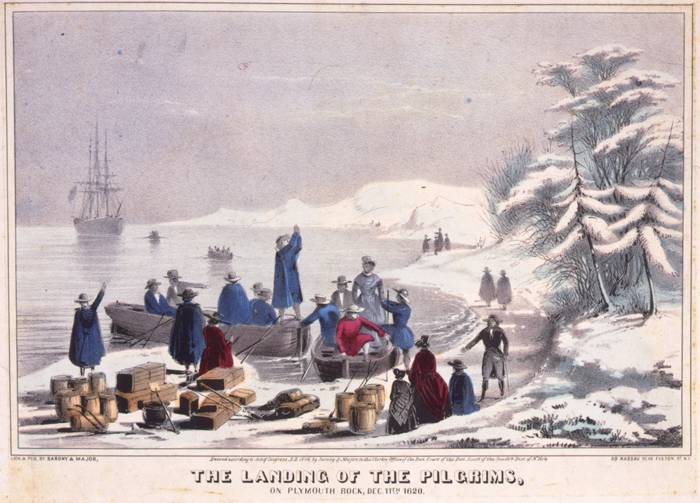
When The Mayflower took off with 101 men, women and children on its 66-day trip across the Atlantic, the ship's ultimate destination was the land where New York City is located today. Due to some unanticipated heavy winds, the Pilgrims had to settle for settling in what would later become Massachusetts.
2. The Native Americans didn't join the Pilgrims out of sympathy
On an early autumn day in 1621, four Pilgrims headed out into the woods, muskets-on-shoulders, in search of some food for a harvest celebration. When members of the Wampanoag tribe heard gunshots, they alerted Massasoit -- their leader -- who promptly gathered 90 warriors to go see if the Pilgrims were preparing for war. As we now know, it was a false alarm, and the Wampanoags joined the Pilgrims for their harvest celebration.
Courtesy of scientopia.org
3. There was no turkey at the first Thanksgiving
Most of the food that we today associate with Thanksgiving was not available back in 1621. Instead of eating turkey, stuffing and mashed potatoes, the Pilgrims and Native Americans ate shellfish, corn and roasted deer meat.
4. The Pilgrims didn't wear buckles at the first Thanksgiving
The Pilgrims didn't wear silver buckles on their shoes and hats, nor did they dress in black, somber attire at the first Thanksgiving. Instead, they dressed in bright colors. Furthermore, despite popular depictions, the Native Americans didn't wear extravagant feathered headdresses or woven blankets at the first Thanksgiving.
5. The Pilgrims didn't call it 'Thanksgiving'
While the Pilgrims did offer thanks to God at the first Thanksgiving in 1621, they didn't call the event 'Thanksgiving.' It wouldn't be until 1623 that the first religious 'Day of Thanksgiving' would be recorded. This first Thanksgiving, however, was held in response to rainfall, not the fall harvest. Overtime, the Pilgrims' harvest celebration and 'Day of Thanksgiving' evolved into a single event. Abraham Lincoln kicked off the American tradition of an annual, national Thanksgiving in 1863.